




Thompson Region PCN
Have your say
Our PCN has recently expanded to include:
- Clinical Counselling
- Social Work
- Clinical Pharmacist
- Registered Dietitian
- Chronic Condition supports
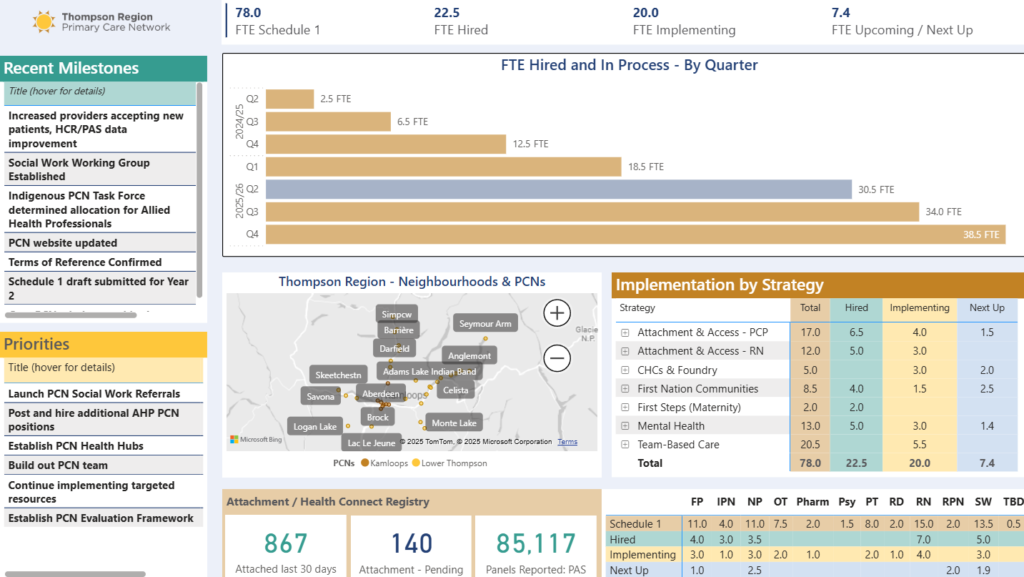
78
Clinical Positions
2
Primary Care Networks
18
Rural Communities
2
Urgent and Primary Care Centres
36
Patient Medical Homes
4
Hospitals and Health Centres
The Thompson Region PCN is made up of the Kamloops and Lower Thompson PCNs, with a combined total population of around 137,000.
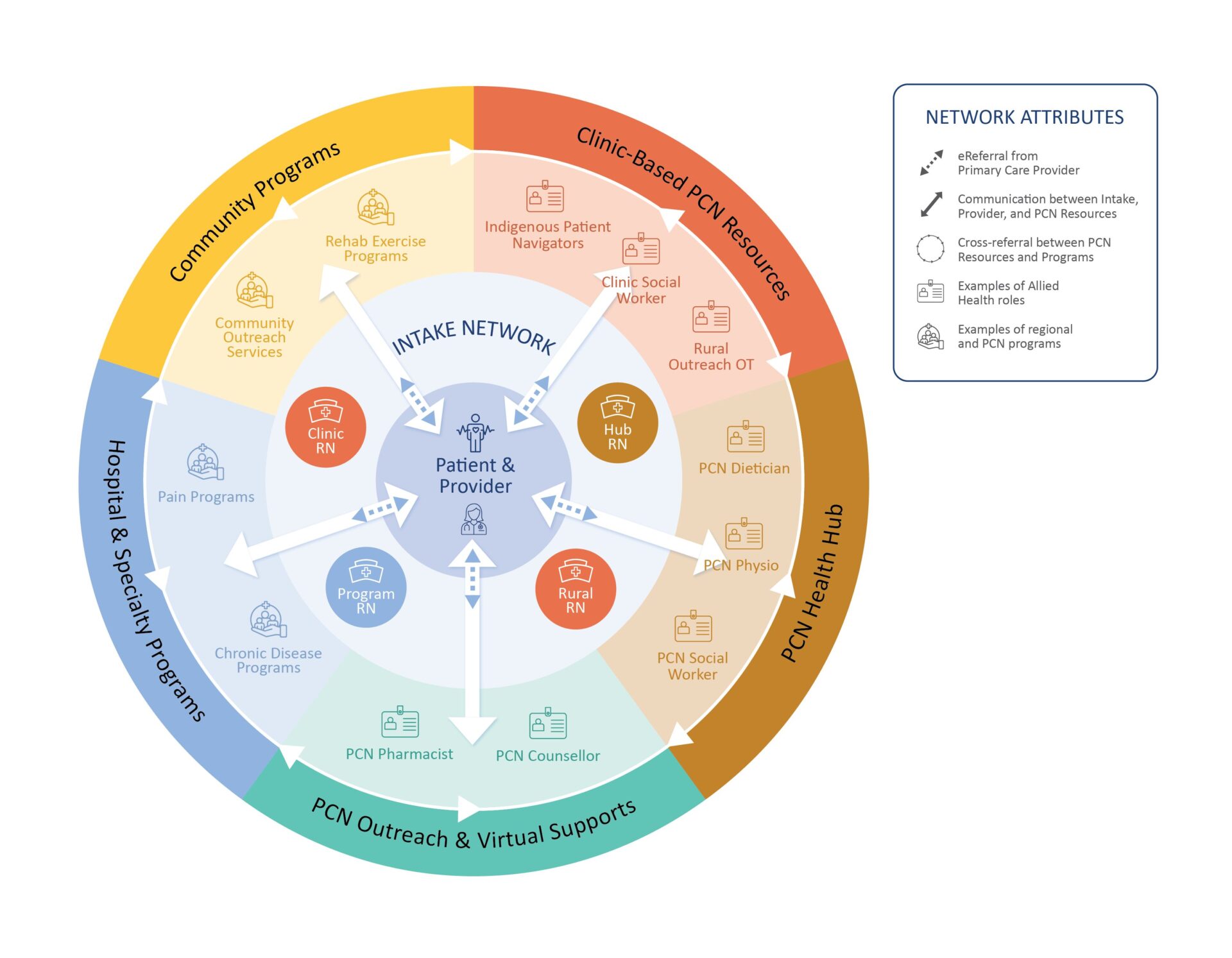
In our PCN, some resources will be co-located within specific practices or communities while others will be based out of a regional Health Hub. Regardless of where team members are located, they will be networked across the region, connected through shared digital tools, regular communication, and coordinated workflows.
PCN Resources & Info
The PCN Health Hub is now open, located within the North Shore Urgent and Primary Care Centre.
The Hub is a central location where many PCN-funded positions are based, providing clinical support, regional programming, and care coordination. Providers across the region can now refer patients to these shared PCN resources.
Core PCN Attributes
Delivery of longitudinal primary care to everyone within a PCN via attachment to a primary care provider or enrollment to a clinic.
Coordination of care with diagnostic services, hospital care, specialty care, surgical services provided in community, and specialized community services for all patients, with particular emphasis on those with mental health and substance use challenges, complex medical conditions, or frailty.
Access to care within 24 hours for urgently needed, non-life-threatening primary care conditions; and access to non-urgent appointments within 7 days.
Provision of extended hours through in-person care including weekdays 5p-8p, weekends and holidays 9a-5p, and virtual after-hours access to a provider at an established call group.
Access to a full-range of primary care services including clinical screening, diagnostic testing, and treatment provided through different clinical settings (eg community-based clinics, virtual care services, mobile outreach, long-term care facilities, in-patient care facilities).
Enablement of health care practitioners from different professional backgrounds (eg FP, NP, nurses, allied health providers, and administrative staff) to work together as integrated primary care teams within clinics and across the network.
Commitment to improving community health needs at the PCN level by achieving optimal population health outcomes through collaboration (with other sectors) to address the social determinants of health.
Enable information continuity for face to face and virtual primary care services through the adoption of provincially/regionally endorsed digital technology solutions.
Commitment to reconciliation and humility in health care and provision of care that is culturally safe, free of racism or discrimination, and respects dignity, well-being, and unique health care needs of Indigenous Peoples.
Removal of systemic barriers to ensure everyone is supported in achieving good health and wellbeing, regardless of age, ability, socio-economic status, ethnicity, gender, sexuality, or geographic location.
Thompson Region PCN – A Networked Approach
The Thompson Region PCN is implementing a networked approach to transform how primary care is delivered. By connecting all PCN-funded resources – whether co-located in clinics, located in a health hub, or serving rural or Indigenous communities – we aim to create a more integrated, flexible, and equitable care system.
This model supports seamless access to team-based care and strengthens collaboration across practices, using digital tools to maintain strong patient-provider relationships, regardless of location.
What does this mean for you?
- Faster, simpler, more coordinated referrals
- Reduced administrative burden with central PCN intake
- Improved communication and continuity of care
Team-Based Care
By leveraging a diverse clinical team, we are building a flexible and equitable system that enables all providers to work to their full scope and supports strong, longitudinal relationships between patients and their care teams.
Roles in Primary Care
- Family Physicians & Nurse Practitioners
- Registered Nurses
- Social Workers & Clinical Counsellor
- Clinical Pharmacists
- Indigenous Patient Navigators
- Physiotherapists
- Occupational Therapists
- Registered Dietitians
PCN Events
Attend one of our upcoming information sessions or watch past recordings.
Past PCN Events and Presentations
- Meet the PCN Health Hub team (Short Video, July 9, 2026)
- Hypertension in Primary Care (Highlight Video, July 9, 2026)
- Hypertension in Primary Care (Recording, May 6, 2026)
- Introduction to PCN Pharmacist and Dietitian (Recording, February 2026)
- Practical Tools and Resources for Chronic Pain (Recording, January 2026)
- Nonpharmacological Approaches to Chronic Pain (Recording, October 2025)
- Meet your PCN Social Workers and Counsellors (Recording, September 2025)
- Networked Approach – Ask Us Anything (Recording, May 2025)
- PCN Health Hubs (Recording, Lunch & Learn, March 2025)
- Introduction to the Thompson Region PCN (Recording, Lunch & Learn, December 2024, password Webinar@209)
Provincial Attachment System
- PAS Panel Optimization (Rapid Fire Recording, August 18)
- PAS Panel Optimization (Rapid Fire Recording, July 14)
- Double Trouble – Reviewing MRP Status in PAS (Rapid Fire Recording, Oct 2025)
- Provincial Attachment System Overview (Rapid Fire Recording, March 2025)
Get in Touch
- Reach out to your Division PCN team:
- General PCN Questions – pcn@thompsondivision.ca
- Call the Division PCN team – 250.709.0860
- PCN Referrals and Questions:
- Fax referrals – 250.314.2870
- Referral questions – thompsonPCNintake@interiorhealth.ca
- Find the latest forms and wait times on Pathways
